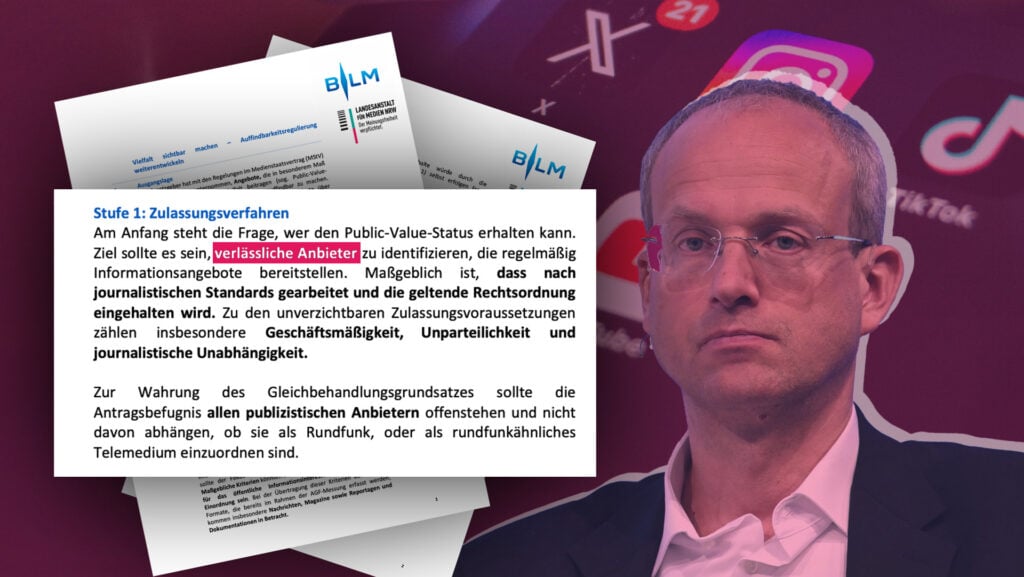
Soon, social media platforms in Germany could be legally required to give preferential treatment to content from certain state-selected media outlets. It would amount to direct government intervention in social media algorithms. And it could be approved within just a few months. Apollo News has obtained plans showing how deeply regulators intend to intervene in the algorithm of social media platforms.
The proposed algorithmic intervention is being pursued under the banner of “public value media” — media outlets deemed to provide “public value.” The decision over which outlets qualify would rest with Germany’s state media authorities, which, despite being labeled “independent of the government,” are in effect government regulatory bodies. For precisely that reason, their powers were long kept highly limited, though they have been expanded step by step in recent years.
“In the summer, the German states intend to present a first draft of the Digital Media State Treaty,” Thorsten Schmiege recently said in an interview. Schmiege is president of the Bavarian Regulatory Authority for New Media (BLM) and, more significantly, chairman of the Directors’ Conference of the State Media Authorities — making him Germany’s top media regulator. In Germany, media regulation falls under the purview of the individual states, but it is governed through interstate treaties and coordinated nationally through the Directors’ Conference, which Schmiege chairs.
Requiring „reliable information“ in social media feeds
The new draft for the interstate media treaty, he said, would also address “how reliable information can be brought more prominently into feeds.” More specifically: “In recent months, we have been dealing with public value — meaning offerings with social added value — in non-linear media. We have developed a model for how this can work legally and technically.”
Apollo News has now obtained the model Schmiege was referring to. The document, prepared by Schmiege’s own Bavarian authority together with the Media Authority of North Rhine-Westphalia and apparently intended for the Directors’ Conference, is titled “Paper on the Further Development of Public Value.” It outlines how the “public value” principle — only recently enshrined in law and currently applicable only to app stores — could be significantly expanded.
Already today, app stores in Germany are required to give preferential treatment to apps from certain media outlets that have been granted the “public value” label by state media authorities. But for many of those authorities, that does not go nearly far enough.
As the paper explains, the current framework grants special status only to “entire media offerings” — in other words, apps — but not yet to “individual pieces of content,” such as articles, videos or social media posts from those outlets on social media. If the chairman of the Directors’ Conference of the State Media Authorities has his way, that is about to change.
Targeting “disinformative content”
“The public value approach should therefore be developed from an offering-based logic into a content-based logic,” the paper obtained by Apollo News states. Media consumption, it argues, is increasingly taking place on social media. There, the paper says, there is a risk that “disinformative, polarizing or merely attention-grabbing content is systematically advantaged.” This, it warns, would erode “the factual and informational foundation of public discourse.” It continues: “This is not a technical footnote, but a core democratic question.”
The proposed solution: intervention in social media algorithms. The paper suggests a multi-step process. First, entire media outlets would be granted “public value” status. These would be “reliable providers” that work “according to journalistic standards” and comply with “the applicable legal order.” Any outlet could apply — but the final decision would lie with the state authorities.
In a second step, individual pieces of content — articles or videos, for example — could then be classified as “public value.” The criteria: “topicality, relevance to the public interest in information and journalistic contextualization.” In other words, individual reports, news items or documentaries could be awarded this status. The outlets themselves would be responsible for labeling the content as providing public added value.
The decisive step, however, comes next: “The labeled content should be made easier to find in algorithmic recommendation systems.” In practice, that would mean individual articles from selected media outlets being favored in social media feeds — after an initial selection of outlets by a government authority. To make that happen, the algorithms would have to be changed: “Algorithmic recommendation systems should be regulated when, through their intermediary function, they substantially shape the visibility of journalistic-editorial content and thereby affect opinion formation.” This would primarily apply to large platforms — presumably X, Facebook, Instagram and TikTok.
A quota for “reliable” content
The platforms themselves would be required to implement the algorithmic changes. Under the proposal, they would have to present the state media authorities with “a comprehensible and measurable concept for how easier discoverability will be ensured.” The introduction of a “statutory quota” for the display of “public value content” is described as “purposeful.” That would mean the state dictating to social media companies how they must operate their products in order to shape public opinion in Germany.
But who decides whether a broadcasting service or online outlet receives this status? That power lies with the interstate Commission on Licensing and Supervision, known as ZAK, where the heads of Germany’s 14 state media authorities work together. These heads — whether presidents or directors by title — are elected by the respective media councils. The members of those councils are, depending on the state, appointed either wholly or in part by the state parliaments. Politics therefore exerts indirect influence over the orientation of the commission that decides how media outlets are classified and how internet platforms are regulated.
Most citizens are likely unaware that, as noted above, a weaker version of the “public value” instrument already exists. Media outlets that have been granted “public value” status by the state media authorities must already be made easy to find on user interfaces such as smart TVs, app stores and screens in cars. Under the state media authorities’ statute, a media offering has public added value if it “makes a particular contribution to diversity of opinion and offerings in the federal territory” and “generally follows recognized journalistic principles.”
The latter may sound harmless at first, but it already represented a small revolution: a government authority decides who follows “journalistic principles” and who does not. This became possible only through a 2020 amendment to the Interstate Media Treaty, which introduced state oversight by the state media authorities under Section 19. Under that provision, for example, the Berlin-Brandenburg media authority reprimanded the online outlet Nius over a report about refugees having dental work done in Germany — all of this even before the introduction of the “public value” requirement for app stores.
A state-approved ranking of media outlets
All “public value” media outlets must now comply not only with the public added-value requirement but also with those Section 19 rules. In 2025, the status was granted for the first time to a number of media offerings, including the public broadcasting channels ARD and ZDF, which are funded through state-mandated fees, as well as the Welt app, the Bild mobile app and numerous regional radio stations such as Radio Potsdam.
For all offerings that receive the status, there is in turn a “recommended” order in which they should be presented. Public-funded ARD and ZDF occupy the top spots. Although this ranking is not formally binding, according to the FAQ on “public value,” the document nevertheless states: “Anyone who sorts according to the recommendations is sorting in a reliably non-discriminatory manner” — in other words, they are on safe legal ground. It continues: “Adopting the recommendation is therefore strongly advised.”
In summary, the plans to revise the Interstate Media Treaty could amount to a sweeping intervention by the media authorities — and thus by the state — into social media and the personal user experience.
It is, in a sense, a form of reverse censorship: unwanted content is not removed, but preferred content is forcibly pushed to the forefront. Supporters of the proposal will no doubt argue that this is only about “easy discoverability,” not explicit preferential treatment. In other words, “public value” media and content would not necessarily be displayed better than other content, only never worse. But in practice, that is just as much a form of preferential treatment — and little more than a semantic reframing of the project.
Teilen:



 Freund werden
 Marie Rahenbrock
 Sebastian Thormann